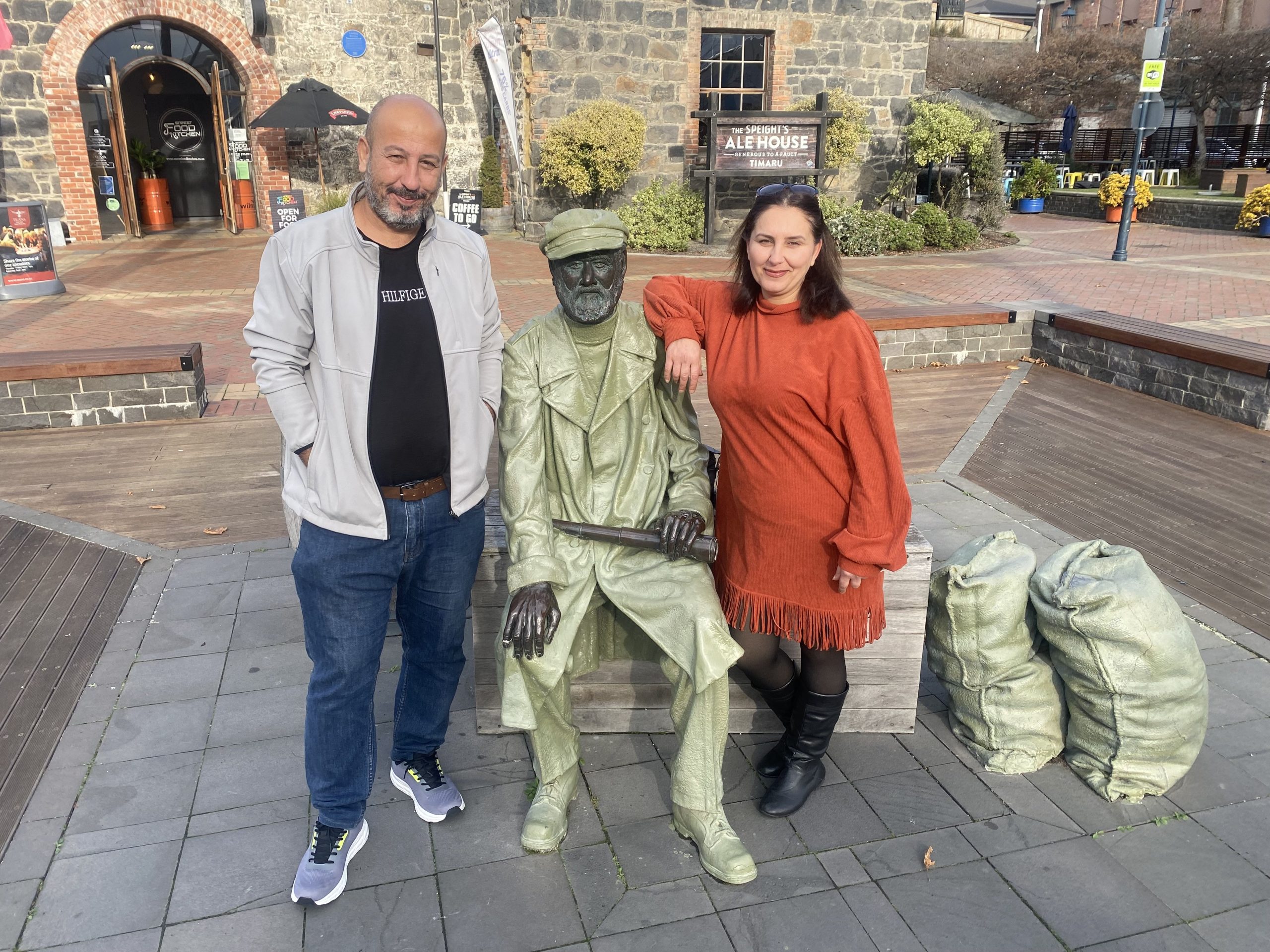
To mark World Refugee Day on June 20, former refugee Juan Bero talked to reporter Shelley Inon about his journey home to Timaru.
Up to a year after arriving in Timaru, Juan Bero said he would often wake up disorientated and it would take a while for his brain to process where he was.
Mr Bero — a Kurd — grew up in Northeastern Syria.
Kurds came from the rugged, mountainous regions of the Middle East, particularly in the areas of modern-day Turkey, Iran, Iraq and Syria.
While they were the indigenous people to the area, over time they had been the target of prejudice and — at times — persecution.
While there were ‘‘many languages’’ spoken in Syria, Arabic was dominant, especially in education and the government.
There was a reason why one language was used predominantly — he could remember being hit by teachers when he was a young boy for speaking Kurdish at school.
He said sometimes they would use their hand, and sometimes they would use a stick.
He said in government centres speaking Kurdish was forbidden.
The country was made up of 80% Arabic people, 15% Kurdish people, while the remaining 5% were a mixture of other ethnicities including Yazidis and Assyrians.
Before he left Syria, Mr Bero had been a teacher in chemistry. He said when the civil war broke out in 2011, the Kurds attempted to establish self rule; they allowed children to learn in their chosen languages and all religions were treated fairly.
However, the newly-established area faced problems with the Syrian government, and Turkish-backed Islamic opposition groups including Daesh (or Isis).
He said Isis was an organisation many countries invested in to achieve their objectives.
‘‘Whether secretly or publicly, while everyone publicly declared their rejection of it.’’
When the United States of America abruptly withdrew their troops from Syria on October 6, 2019, it allowed Turkey the chance to advance on Washington’s long-time Kurdish allies.
It only took three days for the opposition to make its move.
Turkey launched a military offensive in the area dubbed Operation Peace Spring.
The cross-border invasion targeted US-backed Kurdish forces.
The couple and their three children were forced to flee to Iraqi Kurdistan.
When Mr Bero arrived he found there was no way he could find a job as a teacher as the country did not accept his teaching certificate.
Instead, he started work at a factory making dresses for women.
‘‘I was working long hours, starting at 8am and finishing at 6pm.’’
He would receive the equivalent to $US150 ($NZ263) a month.
The family were renting an old house with bad ceilings and walls, the rent was $US50 a month, while $US20 went to electricity and then he had to scrape out money for gas.
He was left with only $US50 to $US70 a month to feed his children.
While the family had previously enjoyed meal time, they began to see making food as simply for survival, not for enjoyment.
When the war died down three months later, they returned home.
‘‘If you grow up in any place, you love this place because you have your family, friends and memories there.’’
He said when they returned, basic services like fuel, electricity and education were unavailable and skirmishes continued.
The economy had crashed, inflation had reduced his $US250 teaching pay cheque to $US20.
Mr Bero said in Syria they kept their houses warm with the diesel-powered sobya, but with no way to find or even to buy fuel, the family had to resort to burning anything they could get their hands on just to keep warm, including old clothes and shoes.
He said they put ‘‘anything in the sobya just to feel warm’’.
Electricity would come on for just an hour a day.
Amid the uncertainty, their fourth child was born and it was only a matter of time until the family found themselves in Kurdistan again.
After a thorough investigation of his character, The United Nations contacted him and the person on the end of the phone asked him if he knew where New Zealand was.
Mr Bero thought it was Scotland, so he said it had a female prime minister, it was part of the Commonwealth, and it was very small.
Satisfied he knew exactly where New Zealand was, the person hung up.
It was not until Mr Bero entered the country into Google maps and he saw ‘‘all of the water’’ that he realised where he was going.
‘‘Everything here is green.’’
He thought the weather in Timaru was nice, ‘‘and the city is beautiful’’.
‘‘When I came here and met people, they are very kind.’’
He was thankful to his new country.
‘‘The government gave my children a chance to go to school and make new friends.’’
He was always willing to share his memories and story with local organisations, groups or schools.
He was also very thankful to his wife Newroz Abdo for her support over the years.
‘‘She is a strong woman, who stood by me in the most difficult situations.’’